DEMYSTIFYING CREATIVITY: What Neuroscience Can Teach Us


🎨 Breaking the Myth: Creativity Is Not a Gift, It's a Skill
For years, we believed that creativity was reserved for artists, geniuses and "minds out of the ordinary". The great turnaround that neuroscience brings us is simple and powerful: we are all born with a brain structured to create. Creativity is not a biological exception — it is a natural function. The real differential appears in the way this skill is trained, encouraged and applied throughout life.
Today, creativity has become almost a global corporate slogan. It's in startup pitch decks, in productivity speeches and even in trendy cafeterias that display phrases like "Think outside the cup" on their menus. But the truth is that the human brain has always created solutions for the uncertain, using repertoire, imagination and trial-and-error, long before the term gained buzzword status. Without elaborate aesthetics, without theatrical performance — just with a clear focus on the solution that would solve the problem of the moment.
The ability to create solutions in real time, under pressure and with few resources, became known worldwide through cultures that act before asking permission — and the 'jeitinho brasileiro' is one of the most recognised expressions of this practical thinking. Neuroscience merely highlights the mechanism behind the global admiration: creativity is not about having everything, but rather about quickly connecting what we have and testing it in the act.
Understanding what really happens in the brain when we create is not just interesting — it is transformative for the way we think about work, studies and personal innovation. Here, then, neuroscience shines by allowing us to name, understand and optimise processes that previously seemed subjective, transforming creativity into a clear and scalable competence, like any other skill inside or outside the corporate environment.
Sources: Draganski et al., 2004; Jung-Beeman et al., 2004; Byron & Khazanchi, 2011.
💡 What happens in the brain when we "have an idea"?
(Recapping the previous post)

Creativity emerges when three major neural networks work together, like an internal multifunctional team:
🧩 Default Mode Network (DMN) → responsible for free associations and unlikely connections.
🧠Executive Control Network (ECN) → evaluates the viability of the idea and leads execution.
🎯Salience Network (SN) → neural curation: decides what deserves immediate attention.
It's not chaos. It's efficient cognitive governance in action.
The why of this is fundamental: good ideas appear when the DMN has freedom to generate non-obvious connections before the ECN applies the logical filter. The SN balances these forces, ensuring that the brain creates without getting lost, and delivers without stifling innovation.
Sources: Beaty et al., 2016; Menon & Uddin, 2010; Cairney et al., 2013 (memory and offline recombination)
⏳ The creative brain needs "idle time"

Studies show that the creation process that happens in the DMN is most active when we are not focused on specific tasks, as it allows the brain to make crossings of repertoire and memories to identify unlikely patterns. This is exactly why insights appear in the shower, whilst driving or before sleeping: in these moments, there is no threat, there is no internal pressure — there is favourable neural incubation.
The corporate world adopted this practice even before science labelled it. Companies like Google and 3M institutionalised policies of time dedicated to personal creative exploration, with a clear intention: to reduce the rigidity of continuous focus and increase creative recombination allowing the brain to work with more dopamine and less analytical pressure. From this philosophy products like Gmail and Post-it were born — not by coincidence, but because the neural permission to create was activated at the right time.
Sources: Smith & Blankenship, 1989; Sio & Ormerod, 2009; Amabile et al., 2002 (environment and creativity)
🚧 Creativity loves constraint (yes, and this has a scientific reason!)

The brain needs not only freedom and the right time for creation, but demand and often rules to delimit the scope of its production. So, when the brain is placed under constraint of time, resources or context, it enters a mode of diversified resolution of possibilities. And this happens because limitations activate the prefrontal cortex, especially the area involved in flexible thinking and creative resolution, reducing cognitive blocking and forcing the search for alternative paths.
The classic example that proves this point with mastery is once again the behaviour of Dr. Seuss: he wrote Green Eggs and Ham accepting a challenge to use only 50 different words. The intention was not minimalist linguistics but rather to prove that clear rules and few resources do not kill the creative flow: they accelerate it. And it worked because the brain was not being judged — it was being challenged with playful intention and emotional deadline without personal threat.
Tools like the SCAMPER method exist exactly with this intention: not to follow a list of steps, but to create a logical path that leads the DMN to diversify solutions without being blocked by the immediate judgement of the ECN, using substitution, combination and reversal to find viable ideas under healthy pressure, yet without personal threat.
Sources: Stokes, 2005; Chrysikou, 2018; Byron & Khazanchi, 2011.
🫀 Physical movement = fuel for recombination of ideas

But healthy pressure alone is not enough. The creative process needs a favourable environment — and this includes physical movement.
Jobs was known for doing walking meetings because he realised that the brain creates better when it is in light movement. Stanford later reinforced the intuition with numbers: walking increases creativity by up to 60% compared to the seated state. This happens because movement:
improves blood circulation in the brain 🩸
increases levels of BDNF, which strengthens the capacity to generate new synapses 🌱
reduces analytical rigidity, favouring non-obvious connections 🔓
In other words: walking does not "create" the idea but creates the biological environment for it to emerge better, faster and with less friction.
And it is curious how history repeats itself: Zuckerberg, Jack Dorsey and Darwin had the same habit, each in their own time and context, not because they talked about creativity, but because they lived creativity in practice, giving the brain space to incubate before delivering.
Sources: Oppezzo & Schwartz, 2014; Cotman & Berchtold, 2002; Erickson et al., 2011.
🎨 Diversity of experiences is literally expansion of neural bank of possibilities
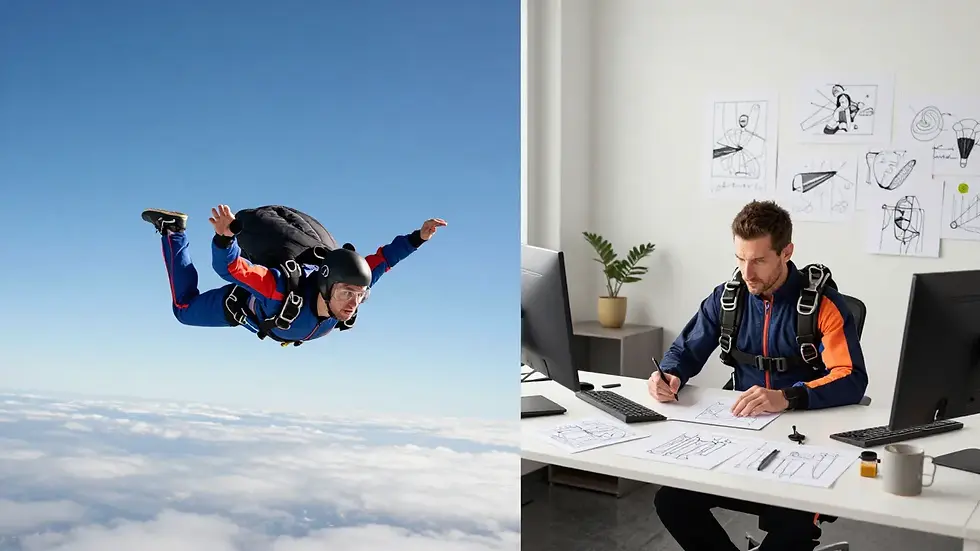
Each new experience creates new synapses. The more diversified the cognitive repertoire, the faster the brain finds unlikely connections — and this applies both to a reflective walk and to skydiving. But it is a fact that the freedom to learn and the constraint to apply are a good pair when it comes to creativity.
The brain needs repertoire, database, cognitive raw material. Each new experience creates new synapses. The more diversified the repertoire, the faster the brain finds unlikely connections and delivers creative solutions when a problem arises.
At Pixar, animators take courses outside their speciality because the intention there is clear: to enrich the repertoire of neural connections, strengthening divergent thinking — which is nothing more than the brain saying: "okay, this problem is not linear. I need more possible paths."
It is necessary to grasp this: creativity does not only grow when "there isn't", it also grows when "there is a bit of everything" — as long as the brain has been fed with diversity of cognitive input and permission to test multiple correlations, without pressure for immediate perfection.
• "Divergent thinking" → ability to generate multiple solutions for a single problem.
And the why of this? Because the brain needs variety to recombine. The more different input, the more solutions arrive ready.
And in the night shift, when the brain switches off judgement and does "backup" of memories, creativity is also optimised.
Sources: Zabelina & Andrews-Hanna, 2016; Guilford, 1967 (original concept of divergent thinking).
😴Sleep Is Creativity's Best Friend

The reason why McCartney woke up with the melody of Yesterday in his head and Mendeleev visualised the periodic table in a dream is not folklore of the extraordinary. It is operational neurobiology. In REM, the brain:
reorganises memories
discards irrelevant noise
remixes acquired learnings
strengthens non-obvious connections
This does not create the idea for you but authorises the DMN to work with more efficiency without freezing because the ECN was switched off from judgement and switched on to system maintenance.
Those who sleep well, according to studies, have 33% more chances of making creative connections between apparently unrelated ideas.
Sources: Cai et al., 2009; Stickgold & Walker, 2013; Mednick et al., 1962 (sleep and remote associations).
📚 Scientific references used in the text:
Draganski et al., 2004 – Experience-induced plasticity
Jung-Beeman et al., 2004 – Classic study on insight and DMN
Smith & Blankenship, 1989 – Incubation and creative blocks
Sio & Ormerod, 2009 – Meta-analysis on creative incubation
Beaty et al., 2016 – Interplay DMN/ECN/Divergent Thinking
Menon & Uddin, 2010 – Salience Network and prioritisation
Cotman & Berchtold, 2002; Erickson et al., 2011 – Physical exercise and increase of BDNF
Oppezzo & Schwartz, 2014 – Walking increases 60% creativity in ideative tasks
Stokes, 2005; Byron & Khazanchi, 2011 – Creative constraints
Zabelina & Andrews-Hanna, 2016 – Diversity of repertoire and recombination
Cai et al., 2009; Stickgold & Walker, 2013 – REM sleep and creativity
✨Conclusion

The great lesson that neuroscience teaches us is creativity is not magic, it is method. Your brain has an incredible capacity to adapt and create - neuroplasticity guarantees this.
Creativity is flow, it is direction, it is mental prototyping, it is post-delivery refinement. It is not lightning. It is neural process. It is a skill that grows when the brain has inputs, clear briefings, favourable neurochemical environment, high BDNF and REM sleep up to date.
Each small change in your daily life - a walk, a different reading, a well-slept night - is literally reconfiguring your brain to be more creative.
The final question is not "am I creative?" but rather "how will I train my creativity today?"
🚀 Challenge: Choose ONE technique from this text and practise for 7 days. Observe what changes. Your brain will thank you!


Comentários