AWAKEN YOUR CREATIVITY: 5 Neuroscience-Based Exercises to Innovate in Everyday Life


🧠 5 Neuroscience-Based Exercises to Innovate
Creativity isn't a gift reserved for the few — it's a capacity that can be trained and strengthened. And neuroscience has shown that small daily practices can unlock neural pathways, make thinking more flexible and generate ideas that wouldn't appear on "autopilot".
If you feel you need more innovative ideas at work, in your studies or in your personal life, here are 5 practical exercises based on scientific evidence to awaken your creativity in everyday life.
These exercises are used in innovation environments, universities and creativity laboratories — and they work because they speak directly to brain networks essential for generating new ideas.
🧬 What Happens in Your Brain When You Train Creativity?
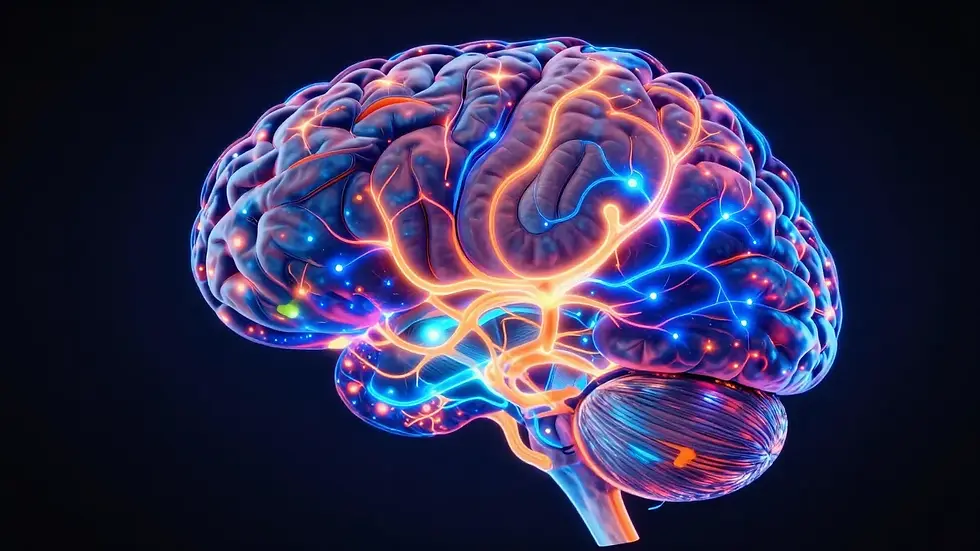
Before we dive into the exercises, it's important to understand what's happening in your brain when you stimulate creativity.
Creativity isn't controlled by a single brain area — it's the result of a complex network of regions working together:
🔹 Prefrontal Cortex (PFC)
Responsible for flexible thinking, planning and problem-solving. When you practise creative exercises, the PFC becomes more efficient at switching between different ideas and perspectives.
🔹 Default Mode Network (DMN)
Active when you're at rest or daydreaming. This is where spontaneous insights and unusual connections arise. Walking, resting and allowing boredom strengthen this network.
🔹 Temporal Lobe
Involved in semantic memory and idea associations. Techniques like random connections stimulate this area, allowing you to make links between apparently disconnected concepts.
🔹 Basal Ganglia and Dopamine
Creativity also depends on motivation and reward. When you experience something new or solve a problem in an innovative way, your brain releases dopamine, reinforcing this behaviour and making it easier to repeat in the future.
🔹 Neuroplasticity in Action
Each time you practise these exercises, you're creating new neural connections (synapses) and strengthening existing pathways. Over time, your brain becomes naturally more creative, agile and adaptable.
💡 Why Does This Matter?

Training creativity not only improves your ability to generate ideas — it also:
• Increases cognitive flexibility (the ability to change perspective),
• Improves the resolution of complex problems,
• Reduces stress (by allowing the brain to rest and process information),
• Strengthens memory and learning (new neural connections facilitate knowledge absorption).
Now that you know what's happening behind the scenes, let's move on to the practical exercises that will put all of this into action.

1️⃣ Divergent Thinking: The 30 Circles Technique
What it is:
A classic exercise created by psychologist Bob McKim, used to stimulate divergent thinking — the ability to generate multiple solutions to a problem.
How to do it:
• Draw 30 circles on a sheet of paper.
• In 3 minutes, transform as many circles as possible into different objects (e.g. clock, pizza, wheel, sun, etc.).
• Don't judge your ideas — just produce as many as possible.
Why it works:
This exercise activates the dorsolateral prefrontal cortex, a region associated with cognitive flexibility and idea generation. The more you practise, the faster your brain learns to think "outside the box".
Try using this technique before brainstorming meetings or when you're stuck on a project.

2️⃣ Creative Walks: Move the Body, Free the Mind
What it is:
Walking — especially outdoors — has a direct impact on creativity.
How to do it:
• Set aside 20-30 minutes to walk without a fixed destination.
• Leave your mobile on silent mode or at home.
• Allow your mind to wander freely, without forcing solutions.
Why it works:
Studies from Stanford University show that walking increases creativity by up to 60%. Physical movement activates the brain's default mode network (DMN), responsible for insights and unusual connections.
If you're stuck on a complex problem, go for a walk. Often, the solution appears when you stop forcing the solution.
Complementary link:

3️⃣ Creative Constraints: Less Is More
What it is:
Paradoxically, having fewer options can increase creativity. Constraints force the brain to find innovative solutions within defined limits.
How to do it:
• Choose a project and impose a constraint (e.g. use only 3 colours, write with 100 words, create something in 10 minutes).
• Work within that limit and observe how your mind adapts.
Why it works:
Constraints activate associative thinking, forcing the brain to make unusual connections. This is why many artists and writers thrive under pressure.
If you need to create a presentation, try doing it with only 5 slides. This forces clarity and innovation.

4️⃣ Random Connections: The Random Word Method
What it is:
A brainstorming technique created by Edward de Bono, which uses random words to generate new ideas.
How to do it:
• Choose a random word (it can be from a dictionary, book or online generator).
• Relate that word to the problem you're trying to solve.
• Note down all the connections that arise, however absurd they may seem.
Why it works:
This exercise forces the brain to create unusual associations, activating areas related to creativity, such as the temporal lobe and prefrontal cortex.
If you're creating a marketing campaign, take, for example, the word "ocean" and see what ideas emerge: fluidity, depth, waves, movement, vastness...
Complementary link:

5️⃣ Creative Rest: The Power of Boredom
What it is:
Allowing the brain to rest — without constant stimuli — is essential for creativity.
How to do it:
• Set aside 10-15 minutes a day to do nothing: no mobile, no music, no distractions.
• Just sit, breathe and let your mind wander.
Why it works:
Boredom activates the brain's default mode network (DMN), which is when the best insights occur. It's in this state that the brain processes information, makes connections and generates creative ideas.
Try being bored in the supermarket queue or in traffic — without reaching for your mobile. Simply observe what emerges.
Complementary link:

EXTRA - The "What If...?" Technique (To break mental rigidity)
🧠 Neuroscientific basis:
Strongly recruits the prefrontal cortex and cognitive flexibility, helping the DMN and ECN to dialogue. And it helps with empathy and team relaxation.
📌 Why it works:
Hypothetical questions reduce the weight of judgement and allow improbable combinations.
How to do it:
Take a real problem from your daily life and write 5 crazy variations starting with "What if…?".
Examples:
• "What if our meeting was forbidden to use PowerPoint?"
• "What if the client could only speak in emojis?"
• "What if we had to solve this in 10 minutes?"
It's not a joke, but it generates lots of laughter allowing the brain to relax — this forces the brain to leave literal mode and explore the divergent.
Try using it in brainstorms, this technique prevents the team from starting with the obvious.
Complementary link:
🔗 How Asking "What If?" Can Lead to Innovation
✨ Conclusion: Creativity isn't born from chance — it's born from practice

The brain creates better when it's provoked with curiosity, novelty, moderate urgency and perspective.
Small exercises like these, repeated with consistency, strengthen the neural networks linked to innovation.
Everyday creativity doesn't require "divine inspiration" — it requires intentional action.
If you try any of the exercises, tell me afterwards.
And of course: if you want a complete workshop on this for teams, just call me. 😉


Comentários