NEUROSCIENCE OF POLITICAL VIOLENCE: Brain Mechanisms in Acts of Extremism

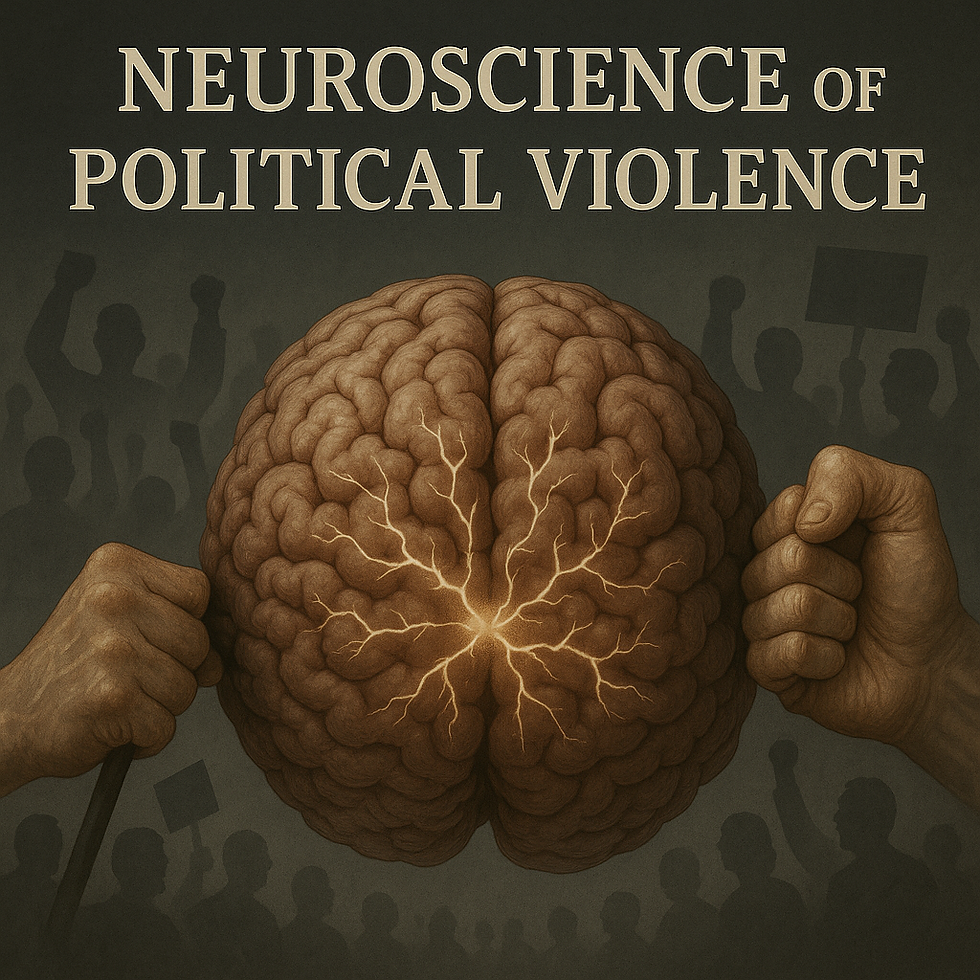
🧠 Neuroscience of Political Violence
Political violence is one of the major contemporary challenges. Acts of extremism do not arise out of nowhere: they are the result of social, cultural and historical contexts which, when combined with specific brain mechanisms, can transform intense emotions into radical behaviours.
These extreme acts – from attacks on institutions to online hate speech – are not only social, but also cerebral. Neuroscience reveals how the brain processes radical ideologies and violent impulses, offering clues to prevention and mitigation.Understanding this intersection between biology and ideology is essential to building societies that are more resilient to extremism.
🔬 What is political violence?

Political violence involves physical, verbal or structural aggression motivated by ideologies, religious beliefs or power disputes. Although often interpreted only from a social perspective, there is an important neurobiological dimension:
Intense emotions (fear, anger, moral outrage) → activate the amygdala, increasing reactivity to perceived threats (LeDoux, 2015).
Group identity → strengthens the dopaminergic reward circuit, generating pleasure and belonging when adhering to the “us versus them” narrative (Amodio & Jost, 2025).
Perception of existential threat → reduces activity in the dorsolateral prefrontal cortex, impairing critical thinking and impulse regulation (van Baar et al., 2021).
These mechanisms do not create ideologies on their own, but they modulate how ideologies are internalised and transformed into behaviour. Political violence begins in the brain, where the perception of threat (to a group, ideology or identity) triggers primitive responses. The amygdala, the centre of fear, detects “danger” in opposing ideas, activating the fight-or-flight mode (LeDoux, 2015). The anterior cingulate cortex (ACC) amplifies conflicts between values, while the prefrontal cortex (PFC) – which regulates impulses – can be overloaded by chronic stress (van Baar et al., 2021).
Extremism is not only ideology – it is amplified emotion. Ingroup bias makes the brain prioritise “our own” and dehumanise “others”, activating the insula in responses of disgust or anger (Cikara et al., 2011). Dopamine reinforces the search for validation, while chronic stress reduces PFC regulation, creating a cycle of radicalisation.
🧩 The brain mechanisms of extremism

Research shows that some circuits are central:
Amygdala: amplifies emotional responses of fear and hostility. This explains why discourses highlighting danger and enemies are so effective.
Prefrontal cortex (dorsolateral and ventromedial): regulates impulse and evaluates consequences. When its activity is suppressed, emotion prevails over reason.
Striatum and dopaminergic system: reward group loyalty. Radical acts may be experienced as moral victories.
Empathy and theory of mind network: when hypoactivated, reduces the ability to see the adversary as human, favouring dehumanisation.
Why does this matter?
Political extremism exploits this circuit: “us vs. them” narratives activate the nucleus accumbens (reward) when group beliefs are confirmed, reinforcing radicalisation (Amodio & Jost, 2025).
🌍 Scientific evidence

Recent studies show that:
Exaggerated amygdala activation occurs when extremists see symbols of rival groups → the brain reads the adversary as a real threat (Zmigrod, 2020).
Low activity in the dorsolateral prefrontal cortex during moral dilemmas → weakens the ability to evaluate the human cost of violence (Falk et al., 2015).
Engagement of the ventral striatum in response to pro-group messages → suggests that radical ideologies function as “social rewards” (Swann et al., 2014).
👉 What does this mean?
This evidence reveals that extremism is not merely ideological: it is sustained by a brain that prioritises threat, group reward and emotion over reason. In other words, it is not simply a matter of “political opinion”, but a reconfiguration of neural processing that favours polarisation.
⚖️ Ethical and social implications

Discussing the neuroscience of political violence raises serious dilemmas:
Free will vs. biological vulnerability → to what extent are individuals who radicalise fully responsible, if their brains are reacting to narratives that exploit emotional biases?
Public policies → deradicalisation programmes need to consider not only discourse, but also emotional regulation techniques and empathy training.
Neurotechnology and manipulation → there is a risk that governments or groups may exploit this knowledge to reinforce propaganda rather than promote dialogue.
The central question is how to use this knowledge to prevent violence without disrespecting individual rights.
🛡️ How not to fall into the trap of extremism

Train critical thinking → question information, especially that which arouses immediate fear or anger. Reframe “they are the enemy” into “they defend a different value” (Gross & Ochsner, 2014).
Exposure to diversity → contact with different perspectives increases the plasticity of the empathy network. Focus on shared values (e.g., security, justice) to activate the default mode network (DMN) (van Baar et al., 2021).
Manage emotions → emotional regulation techniques (mindfulness, breathing, physical exercise) help reduce amygdala reactivity. Label what you feel (“anger, fear”) (Lieberman, 2007).
Cultivate multiple identities → perceiving oneself as a member of several groups (professional, cultural, family) reduces the rigidity of the “us vs. them” mindset (Swann et al., 2014).
🤝 How to deal with someone violently radicalised

Avoid direct confrontation: frontal discussions further activate threat circuits.
Active listening: recognising the person’s emotion can reduce defensiveness.
Focus on shared values: points of convergence activate cooperation areas in the brain.
Do not isolate: social isolation increases vulnerability to radicalisation. Reintegration is more effective than exclusion.
✨ Conclusion

Political violence is written both in history and in the brain. Understanding the neural mechanisms of extremism does not mean absolving, but rather revealing human vulnerabilities that can be either exploited or transformed.
If we know that the brain is plastic, we also know that extremism is not destiny: it can be prevented and reversed.
The choice before us is clear: either we allow fear and hatred to command our neural connections, or we invest in empathy, critical thinking and policies that promote dialogue. Neuroscience shows that the future of democracy depends not only on ballots, but also on synapses.
📚 References
LeDoux, J. E. (2015). The emotional brain revisited. Neuroscience & Biobehavioral Reviews, 46(2), 148–158. https://doi.org/10.1016/j.neubiorev.2014.08.010
Amodio, D. M., & Jost, J. T. (2025). Cognitive–affective dynamics of political attitude polarization. Behavioral Sciences, 15(8), 1043. https://www.mdpi.com/2076-328X/15/8/1043
van Baar, J. M., et al. (2021). Intolerance of uncertainty modulates brain-to-brain synchrony. Proceedings of the National Academy of Sciences, 118(20), e2022491118. https://doi.org/10.1073/pnas.2022491118
Cikara, M., et al. (2011). Us versus them: Social identity shapes neural responses to intergroup competition. Psychological Science, 22(6), 773–779. https://doi.org/10.1177/0956797611407213
Falk, E. B., et al. (2015). Neural correlates of dehumanization. Social Cognitive and Affective Neuroscience, 10(8), 1047–1054. https://doi.org/10.1093/scan/nsu146
BBC. (2025). Brazil’s COP30 tensions spark polarization. https://www.bbc.com/news/articles/cop30-brazil-2025
Zmigrod, L. (2020). A cognitive neuroscience perspective on ideological extremism. Nature Reviews Psychology, 1(3), 123–135. https://doi.org/10.1038/s44159-020-0012-3
Swann, W. B., et al. (2014). Identity fusion: The interplay of personal and social identities. Psychological Review, 121(4), 504–529. https://doi.org/10.1037/a0037781
Horgan, J., & Braddock, K. (2010). Rehabilitating the terrorists? Challenges in assessing the effectiveness of deradicalization programs. Terrorism and Political Violence, 22(2), 267–291. https://doi.org/10.1080/09546551003597570
Gross, J. J., & Ochsner, K. N. (2014). Cognitive emotion regulation. Current Directions in Psychological Science, 23(2), 143–149. https://doi.org/10.1177/0963721413515247
Lieberman, M. D. (2007). Social cognitive neuroscience: A review of core processes. Annual Review of Psychology, 58, 259–289. https://doi.org/10.1146/annurev.psych.58.110405.085654
Leong, Y. C., et al. (2020). Conservative and liberal attitudes drive polarized neural responses. Proceedings of the National Academy of Sciences, 117(44), 27731–27739. https://doi.org/10.1073/pnas.2008530117
The Conversation. (2023). How neuroscience explains political extremism. https://theconversation.com/how-neuroscience-explains-political-extremism-2023
Harvard Business Review. (2020). How to build empathy during conflict. https://hbr.org/2020/06/how-to-build-empathy-during-conflict
Mindful. (2021). How mindfulness can ease conflict. https://www.mindful.org/how-mindfulness-can-ease-conflict/


Comentários