NEUROSCIENCE OF POLARIZATION: How The Brain Reinforces Political Division


🧠 Neuroscience of Polarization: how the brain reinforces political divisions
Have you noticed how the world seems more divided than ever? In Brazil, the trial of Bolsonaro for attempted coup has supporters and opponents almost going at each other’s throats. In the U.S., the assassination of activist Charlie Kirk shocked and inflamed tempers, while Trump’s tariffs threatens thousands of jobs around the world. In France, the prime minister has been replaced for the fifth time under Macron, and in Nepal, violent protests toppled the government over corruption.
Did you know the culprit behind all this might be in your head? But hold on—neuroscience explains how our brain pushes us toward these political divisions—and how they show up in the tensions of 2025. Let’s unpack this cerebral mess and see why we pick sides almost without noticing!
🔬 What is “polarization”

Subheadline: when identity enters the scene, the brain prioritizes “who we are” before “what is true.” Result: more heat than light.
Yes, politics is boiling over in various corners of the world, and, in this scenario, it’s worth separating myth from science: polarization is not just “disagreeing”; polarization is an affective phenomenon—we start to dislike the other side and assume bad intentions, even without being able to name huge disagreements. This effect is robust in the literature and connects directly with how the brain creates and protects group identities.
Affective polarization = seeing the out-group as morally worse, less trustworthy, and “less us.” This couples with social identity theory: when the team badge lights up, perception, memory, and judgment go through the tribe’s filter. In translation: who said it weighs more than what was said.
❓Intolerance of uncertainty: the hidden trigger

It’s not just ideology. People with higher intolerance of uncertainty synchronize brain activity more with those who think like them and desynchronize with the other side when watching the same debate. More “in-group” synchrony = more similar narratives = more extreme opinions afterward—on both sides.
Chronic polarization opens the door to dehumanization: it’s not just “disliking,” it’s not attributing a mind to the other. Studies show hypoactivation in the mPFC (the empathy area) for extreme out-groups and distinct neural signatures between dislike and blatant dehumanization—fertile ground to justify exclusion and aggression.
High confidence in one’s own position alters post-decision processing: it amplifies evidence in favour and dampens the contrary (MEG/fMRI). This reduces changes of mind even with new information—the famous “link bomb” doesn’t convert.
And it’s not just uncertainty that traps us—our brain also reorganizes information to protect our identity.
🧩 The partisan brain: identity first, facts later

When political beliefs become identity, processing reorganizes to maintain coherence with the group. In cognitive neuroscience studies, we see what’s called motivated reasoning: when facing contradictions by “our” candidate, the brain triggers evaluative/affective networks before cool analysis—and rationalizes to protect the tribe. It’s not stupidity; it’s identity self-protection.
Well, what does that mean? Think of it like this: our brain is a bit like a die-hard fan. It loves to belong to a group and defend the “team” tooth and nail. Neuroscience calls this polarization—when our emotions take the wheel and reason goes to the back seat. Studies from 2025 show that, when we hear something political, our brain releases dopamine (the “happiness hormone”) if the news confirms what we already think. But if it goes against our beliefs? Then comes cortisol, stress, and we reject the idea on the spot.
This happens because the brain evolved to live in tribes. Today, social networks like X become our “digital tribes,” amplifying this instinct. A recent study used EEG exams to show that liberals and conservatives process political words differently, with the amygdala (the part of the brain that deals with fear) coming online in a unique way for each group. It’s as if our brain had an automatic “us versus them” filter.
🗣️ Moral language + threat = accelerates divergence
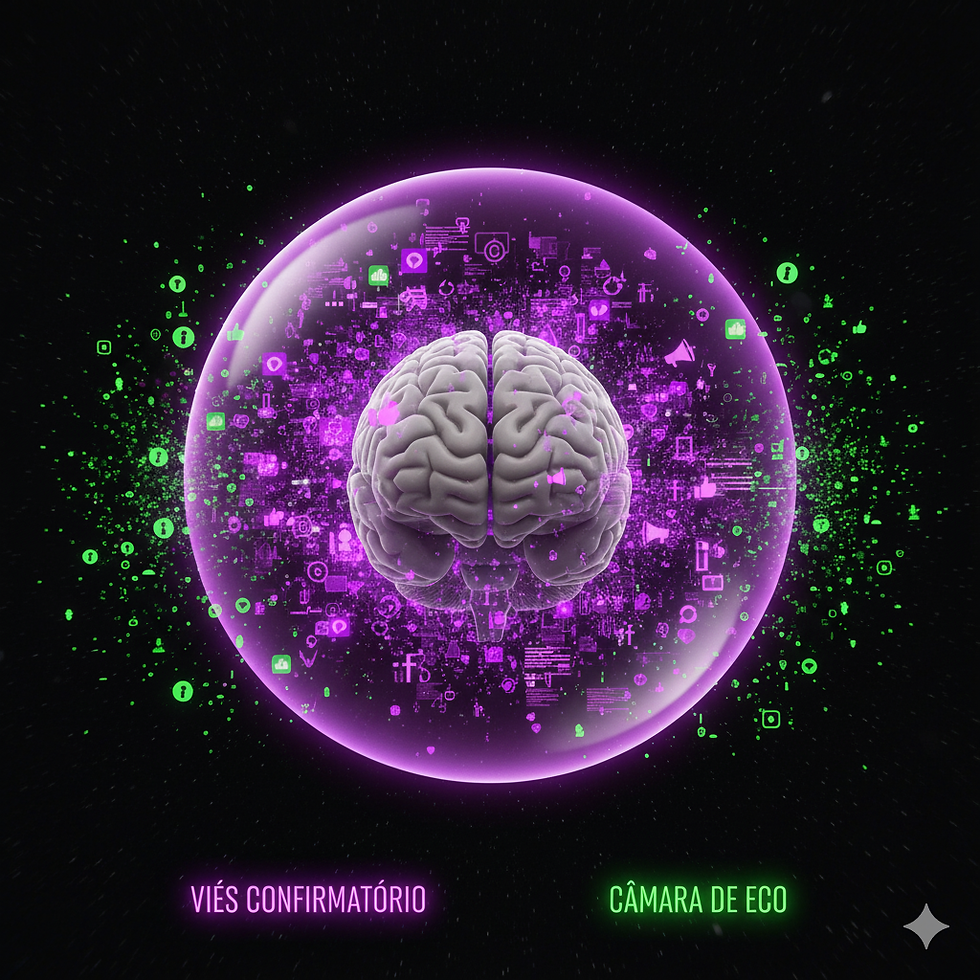
Watching the same political content, liberals’ and conservatives’ brains show more divergent neural responses when the message uses moral-emotional and risk/threat language (with emphasis on regions like the dmPFC linked to narrative interpretation). On social networks, each moral-emotional word in a post increases the chances of virality by ~20%—perfect fuel for echo chambers.
Have you heard of “confirmation bias”? It’s when the brain only pays attention to information that matches what we already believe. Neuroimaging from a 2025 study shows that, when reading political news, the nucleus accumbens (the reward area) activates when we agree, but we “switch off” the cingulate cortex, which detects conflicts, if something challenges our ideas. Result? Facts we don’t like get ignored.
In Brazil, this explains why Bolsonaro’s trial divides so much: supporters see a hero, while opponents see a threat to democracy. Each side’s brain reinforces its narrative, as if they were coloured glasses. Our brain loves to “prove” that we’re right: In Nepal, protesters against corruption read only about the government’s failures, while supporters of Oli highlight “stability”; and, in France, Macron’s voters see the PM swaps as “strategy,” but critics see only “chaos.”
In all this, everyone is a victim, and no one is to blame. Here we clearly see how the environment socially shapes the individual to belong to a group. How each brain is individual and unique, because each person receives the same message differently, even when the moral sense and sense of justice are the same.
In fact, what happens is that seeing through confirmation bias reinforces a bubble without being noticed. A bubble that can burst to either side at any moment. Sometimes, with an unexpectedly unnecessary action: The assassination of Charlie Kirk—Republicans blame “radical leftists,” while Democrats focus on “armed extremism”; Protests against corruption in Nepal leave 72 dead in an invasion of parliament. It’s the demonstration of “social pain” (processed in the cingulate cortex) turning into collective fury.
✨Como Sair Dessa? A Neurociência Aponta o Caminho
The good news? The brain can be “hacked” to reduce polarization. Studies suggest that gradually exposing yourself to opposing ideas lowers cortisol and activates empathy areas, like the prefrontal cortex.
How about trying this? The next time a piece of news irritates you, stop and ask: “Why am I feeling this?” It might be the beginning of getting out of the bubble.
Correcting exaggerated metaperceptions (“they support violence”) reduces support for partisan violence—an important effect, even if it doesn’t solve all democratic problems.
No-go: humiliating the other in public, dumping links in a combative tone, or throwing the reader into the opposing timeline without dialogue architecture—on average, hardens identities.
🧭 To take with you (difficult-conversation playbook)
Name the identity: “we’re discussing teams, not just facts.”
Lower moral/threat in the framing; describe uncertainties explicitly.
Check metaperceptions before the merits (“what do you think they actually support?”).
Use a listening script (10–12 min, open questions, personal examples).
Lean into confidence: when someone is 100% sure, the door to the opposing view closes—focus on curiosity and “what if…”.
💓Conclusion
The tensions of 2025—from Brasília to Kathmandu—show that polarization is not just political, it’s cerebral.
Understanding this gives us power to have better dialogue. If we understand the brain, 2025 can be a year of less fighting and more conversation!
And you—have you felt your brain “picking a side”? Tell us in the comments!
📚 Essential references• Iyengar, S., Lelkes, Y., Levendusky, M., Malhotra, N., & Westwood, S. J. (2019). The origins and consequences of affective polarization in the United States. Annual Review of Political Science, 22, 129–146. https://doi.org/10.1146/annurev-polisci-051117-073034• Van Bavel, J. J., & Pereira, A. (2018). The partisan brain: An identity-based model of political belief. Trends in Cognitive Sciences, 22(3), 213–224. https://doi.org/10.1016/j.tics.2018.01.004• Westen, D., Blagov, P. S., Harenski, K., Kilts, C., & Hamann, S. (2006). Neural bases of motivated reasoning: An fMRI study of emotional constraints on partisan political judgment in the 2004 U.S. presidential election. Journal of Cognitive Neuroscience, 18(11), 1947–1958. https://doi.org/10.1162/jocn.2006.18.11.1947• Leong, Y. C., Chen, J., Willer, R., & Zaki, J. (2020). Conservative and liberal attitudes drive polarized neural responses to political content. Proceedings of the National Academy of Sciences, 117(44), 27731–27739. https://doi.org/10.1073/pnas.2008530117• Brady, W. J., Wills, J. A., Jost, J. T., Tucker, J. A., & Van Bavel, J. J. (2017). Emotion shapes the diffusion of moralized content in social networks. Proceedings of the National Academy of Sciences, 114(28), 7313–7318. https://doi.org/10.1073/pnas.1618923114• van Baar, J. M., Halpern, D. J., & FeldmanHall, O. (2021). Intolerance of uncertainty modulates brain-to-brain synchrony during politically polarized perception. Proceedings of the National Academy of Sciences, 118(20), e2022491118. https://doi.org/10.1073/pnas.2022491118• Rollwage, M., Dolan, R. J., & Fleming, S. M. (2020). Confidence drives a neural confirmation bias. Nature Communications, 11(1), 2634. https://doi.org/10.1038/s41467-020-16278-6• Harris, L. T., & Fiske, S. T. (2006). Dehumanizing the lowest of the low: Neuroimaging responses to extreme out-groups. Psychological Science, 17(10), 847–853. https://doi.org/10.1111/j.1467-9280.2006.01793.x• Bruneau, E., Jacoby, N., Kteily, N., & Saxe, R. (2018). Denying humanity: Neural correlates of blatant dehumanization. Journal of Experimental Psychology: General, 147(8), 1078–1093. https://doi.org/10.1037/xge0000418• Bail, C. A., Argyle, L. P., Brown, T. W., Bumpus, J. P., Chen, H., Hunzaker, M. B. F., ... & Volfovsky, A. (2018). Exposure to opposing views on social media can increase political polarization. Proceedings of the National Academy of Sciences, 115(37), 9216–9221. https://doi.org/10.1073/pnas.1804840115• Mernyk, J. S., Pink, S. L., Druckman, J. N., & Willer, R. (2022). Correcting inaccurate metaperceptions reduces partisan conflict. Proceedings of the National Academy of Sciences, 119(3), e2109089119. https://doi.org/10.1073/pnas.2109089119• Broockman, D., & Kalla, J. (2016). Durably reducing transphobia: A field experiment on door-to-door canvassing. Science, 352(6282), 220–224. https://doi.org/10.1126/science.aad9713• Amodio, D. M., & Jost, J. T. (2025). Cognitive–affective dynamics of political attitude polarization: EEG-based behavioral evidence from a COVID-19 vaccine mandate task. Behavioral Sciences, 15(8), 1043. https://www.mdpi.com/2076-328X/15/8/1043• FeldmanHall, O., Chen, J., Leong, Y. C., Norman, K. A., & Hsu, M. (2023). Study offers neurological explanation for how brains bias partisans against new information. Science Advances. https://www.brown.edu/news/2023-02-01/political-brain• Pedras, D. C., & Schmidt, M. (2025). Research: Neuroscience helps explain polarization in Brazil. Estadão. https://www.estadao.com.br/150-anos/republica-em-transformacao/pesquisadores-usam-neurociencia-para-explicar-a-polarizacao-no-pais-confira-as-conclusoes/• Agência Brasil. (2025). STF will have an extra session to continue Bolsonaro’s trial. https://agenciabrasil.ebc.com.br/justica/noticia/2025-09/stf-tera-sessao-extra-para-continuidade-de-julgamento-de-bolsonaro• BBC News Brasil. (2025). Trial of Bolsonaro at the STF: What happened in the first week. https://www.bbc.com/portuguese/articles/c99me8984vlo• Al Jazeera. (2025). Updates: Charlie Kirk, Trump ally, shot and killed; manhunt under way. https://www.aljazeera.com/news/liveblog/2025/9/11/live-charlie-kirk-killing-stokes-fears-of-rise-in-political-assassinations• BBC News Brasil. (2025). Charlie Kirk: FBI releases photos of suspect in activist’s killing. https://www.bbc.com/portuguese/articles/cpq5l88q323o• Agência Brasil. (2025). “Tarifaço” on part of Brazilian exports goes into effect today. https://agenciabrasil.ebc.com.br/economia/noticia/2025-08/tarifaco-sobre-parte-das-exportacoes-brasileiras-entra-em-vigor-hoje• G1. (2025). Sébastian Lecornu is appointed France’s new prime minister by Macron. https://g1.globo.com/mundo/noticia/2025/09/09/macron-nomeia-novo-primeiro-ministro-da-franca.ghtml• G1. (2025). Nepal’s prime minister resigns amid protests against the government. https://g1.globo.com/mundo/noticia/2025/09/09/primeiro-ministro-nepal-renuncia-protestos-contra-governo-mortos.ghtml


Comentários