THE NEUROSCIENCE OF GOALS, FRESH STARTS AND NEW CYCLE

🌙🧠 Why the Brain Loves New Beginnings
Every beginning of the year carries a silent promise of change.
Plans are made, goals are written, and the feeling of a fresh start seems to renew possibilities.
Even when nothing has actually changed — the same job, the same routines, the same challenges — something within us seems to slow down, reorganize, reflect, dream, and prepare for the cycle of the new year.
But did you give yourself that time? Did you feel it and prepare for it?
This process is the body (the brain) quietly beginning to do what it does best: closing narratives to make space for new ones.
And this is not only culture, tradition, or the calendar.
What is happening here is neurobiology working silently behind the scenes.
🧩 1. The Brain and Its Need to Close Cycles

The human brain operates much like a narrative machine.
It needs a beginning, a middle, and an end in order to make sense of life.
If we think about the lifespan of a mental narrative, it often fits within minutes, hours, days, weeks, months, or years.
In many cases, the brain defines a cycle even before we begin a project.
Traditionally, December marks the closing of the annual cycle — the one we collectively measure — while the new begins on 1st January.
It is common for us to make promises of change and plans for the coming year, and on 31st December we either thank ourselves for achieving them or regret having postponed them.
What often goes unnoticed, however, is that three major brain systems are working together to close the year’s cycle:
🔹 Prefrontal Cortex (PFC)
Activated to organize, prioritize, and evaluate what worked and what did not.
Every project, goal, or life phase opens a new mental tab (like a browser tab), gradually increasing cognitive load until it is properly closed.
The brain therefore attempts to close these “open mental tabs” — those opened at the beginning of the year or throughout it — making room for new ones.
🔹 Hippocampus
Retrieves memories from the entire year, creating maps of learning, connections, mistakes, and achievements.
It brings back memories and nostalgia — moments to laugh about, cry about, or celebrate — allowing the PFC to evaluate what worked and what did not.
🔹 Default Mode Network (DMN)
The network associated with introspection that connects past, present, and future.
It allows us to revisit old stories and imagine who we want to become in the next phase.
The DMN helps organize the events of the year so the brain can begin imagining and planning what the future might hold.
When cycles close, cognitive load decreases. Emotions regulate, and the brain prepares for a new beginning.
This is physiology — not superstition.
🌅 2. Fresh Start Effect — The Biological Power of New Beginnings

The well-known Fresh Start Effect (Milkman et al.) helps explain why the brain responds so strongly to turning points:
the first day of the month
Monday
a birthday
January 1st
These temporal markers can create a powerful psychological and biological effect:
they separate “who I was” from “who I can be now”
they reduce emotional noise
they increase dopamine (motivation)
they encourage the beginning of new behaviors
The brain tends to interpret these moments as cognitive portals.
They facilitate change because they create symbolic distance from the past.
That is why starting again on the first day of something often works.
And no — it is not simply a matter of willpower.
🎯 3. What Happens in the Brain When You Define Goals

Creating goals is not merely a motivational act — it is a neurobiological process linked to reward anticipation and dopamine.
Prefrontal Cortex
The first stage of a goal is developed in the PFC, which transforms abstract intentions into concrete planning.
It defines priorities and outlines possible routes.
Dopamine
Part of the reason goal setting itself can feel motivating.
Dopamine is not only released when a goal is achieved — it is also released as we move closer to it.
It functions as a driver of anticipation and progress, rather than simply of final achievement.
This process helps sustain motivation during goal pursuit.
Reward Circuit
Keeps us moving forward, reinforced by each small gain perceived along the way.
It is one of the key mechanisms that keeps a goal active until it is achieved.
Neuroplasticity
Every repeated micro-habit creates new neural pathways.
With repetition, the brain learns the fastest route.
Goals are maps; habits are roads.
Now try a small experiment to evaluate your goals:
Think for a moment about a goal you defined at the beginning of this year (perhaps exercising more, reading more books, or learning something new).
Now ask yourself:
"Did I define a concrete behavior — or just a vague intention?"
⚠️ 4. Why Most Goals Fail (A Realistic Neuro Explanation)
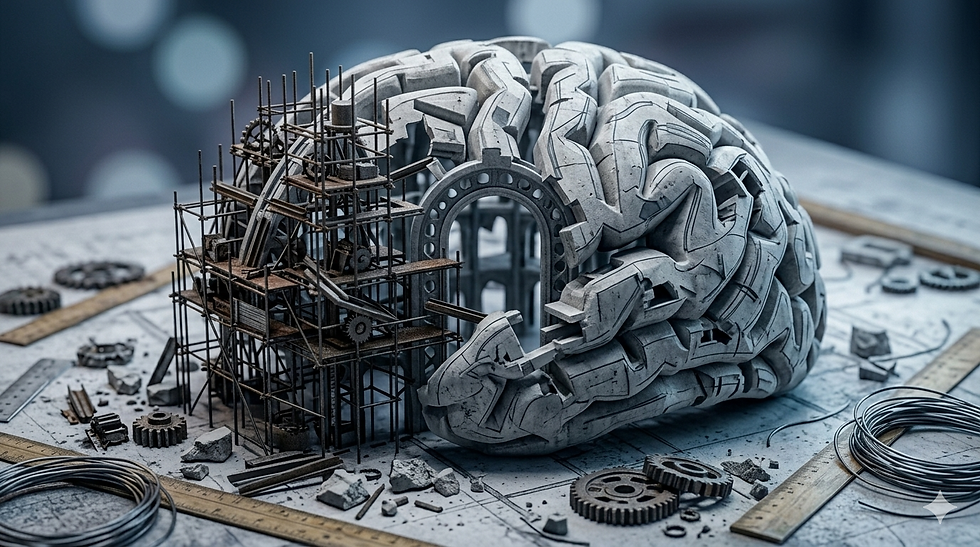
The problem is often not you — it is the design of the goal.
Most goals fail because:
1. They are too abstract
The brain tends to work better with concrete and observable behaviors than with vague or abstract objectives.
The clearer the goal, the easier it is for the brain to design an actionable plan.
2. They do not provide early rewards
Without early dopamine signals, behavior becomes difficult to sustain.
Small rewards along the way help maintain long-term goals.
3. They conflict with the current environment
Environment often wins against intention.
If the environment remains the same, behavior tends to remain the same as well.
Whenever possible, modify the environment. Seek new ideas and remain creative so that monotony and boredom do not lead to abandoning the goal.
4. There is no ritual
Without ritual, neural consolidation becomes more difficult.
Here, ritual does not refer to anything mystical — but rather mental preparation rituals, reflecting on goals and recognizing small achievements along the way.
5. They demand too much energy at the beginning
For the brain, high initial effort often leads to early abandonment.
When a goal demands too much effort at the start, the probability of failure increases because the body and mind are not yet adapted to such a drastic change.
Begin with small adjustments and increase them gradually.The gains tend to be greater and more rewarding.
Goals fail not because of a lack of desire,
but because of insufficient neural architecture.
🌱 5. How to Create Goals Your Brain Will Love to Achieve

Here we enter the territory of practical neuro-application — no magical lists.
✔ Turn goals into clear behaviors
“Read more” becomes: read five pages every morning.
✔ Create progressive dopaminergic loops
Small victories → dopamine → repetition(while introducing variation to avoid boredom).
✔ Stack habits onto existing triggers
After coffee → 10 minutes of writingAfter a shower → a short journal entry
The brain tends to appreciate predictability.
✔ Use internal and external rewards
Reward strengthens newly formed neural pathways.
✔ Build systems, not just desires
Desires inspire.
Systems transform.
✔ Adjust the environment
Well-designed environments often replace the need for willpower.
Good goals do not exhaust — they guide.
💛 6. The Emotional Role of New Cycles

New cycles reorganize more than plans.
They reorganize identity.
The DMN may begin forming new narratives about who we are.
The hippocampus maps new learning.
The PFC projects possible future capabilities.
Beginning a new cycle signals to the nervous system and brain that we are ready to release some of the weight of the past and begin preparing for the future.
It gives us the opportunity to reflect and process the emotions experienced during the closing of a year.
Creating hope is not naïve.
It is a form of emotional neuroregulation.
Starting again helps bring meaning to chaos, organizing our internal sense of time and restoring a feeling of stability and control in life.
✨ Conclusion — The Science Behind Fresh Starts

Starting again is not a human whim.
It is a neurobiological movement of preservation.
Because the brain:
✨ needs to close cycles
✨ needs new beginnings
✨ needs stories
✨ needs direction
Goals are not numbers —
they are emotional maps that guide behavior.
The human brain was built to begin again as many times as necessary.
And each new beginning is a fundamental and silent reorganization of what we may still become.
So tell me:
Have you already gone through your own process of slowing down, reorganizing, reflecting, dreaming, and preparing for the cycle of a new year?

🧠 Three ideas your brain wants you to remember
1️⃣ The brain needs to close cycles
Closing narratives reduces cognitive load and allows new projects to receive mental attention.
2️⃣ Fresh starts are biologically motivating
Temporal milestones activate psychological mechanisms that facilitate behavioral change, as described in the Fresh Start Effect.
3️⃣ Goals work better when they become concrete behaviors
The brain responds better to clear, repeated actions reinforced by dopamine and neuroplasticity.
📚 Related readings and studies
• Katy Milkman et al. (2014). The Fresh Start Effect: Temporal Landmarks Motivate Aspirational Behavior. Management Science.
• Wolfram Schultz (2016). Dopamine reward prediction error coding. Annual Review of Neuroscience.
• Marcus Raichle (2015). The Brain's Default Mode Network. Annual Review of Neuroscience.
• Wendy Wood (2019). Good Habits, Bad Habits: The Science of Making Positive Changes.


Comentários