WHAT IS COGNITIVE NEUROSCIENCE? Understanding the Thinking Brain

🧠 What is Cognitive Neuroscience?
Have you ever stopped to wonder how we manage to focus our attention, remember something, or make decisions? How does the brain transform stimuli into thoughts? In today’s world, understanding how we think, remember, make decisions, and perceive the world around us is more relevant than ever. And the answer lies in cognitive neuroscience.
This scientific field — one of the most fascinating (and complex) branches of modern neuroscience — studies the neural basis of mental processes. In other words, it explores how our brain enables the mind to function, bridging brain science and mind science.
If you've ever heard terms like “prefrontal cortex activation during reasoning” or “brain plasticity linked to memory,” you’ve already encountered themes from cognitive neuroscience. And in this post, we’ll explore what this field actually studies, how it emerged, and why it’s so important. Let’s unravel the neural mechanisms behind the mental functions that shape cognition.

🔬 1. What Does Cognitive Neuroscience Study?
Cognitive neuroscience is an interdisciplinary field that brings together neuroscience, cognitive psychology, linguistics, philosophy of mind, artificial intelligence, and other sciences to investigate how mental processes emerge from brain activity. Its main goal is to identify the neural correlates of cognition — the brain structures and circuits involved in:
Attention: the process of selecting what to focus on while filtering out everything else
Perception: how we interpret and understand sensory stimuli
Memory: acquiring, forming, storing, and retrieving information
Language: how we produce and understand speech and writing — the task of expressing ideas in comprehensible ways
Decision-making: how we evaluate options and choose paths forward
Consciousness: what makes us aware of our thoughts and experiences — "the brain knowing it exists" (António Damásio), arising from the interaction of emotions, body, and mind
🧠 While cognitive psychology studies behavior and mental processes through experiments and theoretical models, cognitive neuroscience adds a powerful dimension: the neural workings behind those processes.
It seeks to answer questions like:
🧩 What happens in the brain when we make a decision?📚 How does the brain form and retrieve memories?🗣️ How do we understand and produce language?
📜 2. Where Did This Field Come From?
The roots of the field trace back to 19th-century studies on brain lesions (like the famous case of Phineas Gage), through the rise of cognitive psychology in the 1950s, to the neuroimaging revolution in recent decades.
The quest to understand the human mind is ancient, but it wasn’t until the “cognitive revolution” of the 1950s–60s that modern cognitive psychology was born.
The term cognitive neuroscience was coined by George Miller and Michael Gazzaniga in 1970 during an interdisciplinary meeting that brought together psychologists, neuroscientists, linguists, and philosophers. The field formally emerged in the 1970s–80s, especially after the publication of Cognitive Neuroscience: The Biology of the Mind by Michael Gazzaniga and colleagues.
Cognitive neuroscience emerged from the fusion of:
Cognitive psychology (mental processes)
Neuroscience (nervous system)
Neuroimaging techniques (like fMRI and EEG), allowing us to see the brain in action
Since the 1990s, the field has exploded with discoveries and practical applications.
📌 Today, cognitive neuroscience is considered a central discipline for understanding the human being — from brain to experience.

🧪 3. How Are Studies in This Field Conducted?
To understand the brain in action, cognitive neuroscience uses techniques like:
🔍 fMRI (functional magnetic resonance imaging) – detects blood flow changes to show which brain areas are active during a task
⚡ EEG (electroencephalogram) – captures real-time brain electrical activity
💡 Cognitive tasks – participants perform tasks while their brain responses are recorded
🧠 Lesion studies – reveal the roles of specific regions by observing the effects of brain damage
📚 TMS (transcranial magnetic stimulation) – manipulates activity in targeted brain areas
🧩 Computational modeling and AI – simulate mental functions and test precise hypotheses
These techniques allow researchers to observe the brain “thinking” in real time — literally watching which regions activate when you read a sentence, solve a problem, or try to remember a phone number.

🧭 4. What Is Cognitive Neuroscience Useful For?
The knowledge generated by this field has practical implications across many domains. Understanding how the brain constructs the mind has real-world applications, such as:
Education: creating teaching methods aligned with how the brain learns
Mental health: improving diagnosis and treatment of conditions like depression, ADHD, and Alzheimer’s
Technology: designing brain-computer interfaces
Justice: analyzing behavior under cognitive influence (neurolaw, accountability, and free will)
Neuroethics: addressing the limits of brain knowledge (manipulation, cognitive enhancement)
In short: cognitive neuroscience helps us understand who we are, how we think, and how to live better.
Currently, the field also explores topics such as:
Altered states of consciousness (e.g., meditation, sleep, psychedelics)
Emotion and empathy
Social and moral cognition
Decision-making in complex environments
Brain-machine interfaces and neurotechnology
🧠 5. What Have We Discovered?
Thanks to cognitive neuroscience, we now know that:
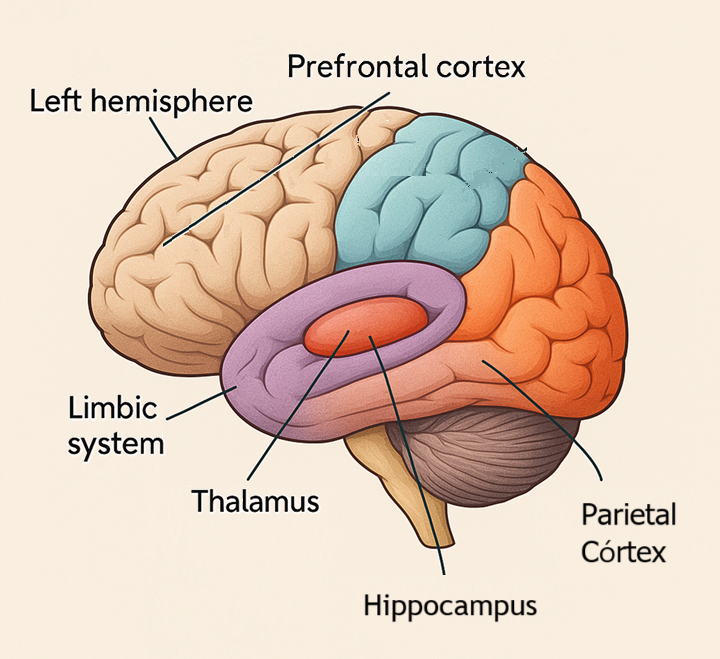
Working memory depends on the prefrontal cortex
The hippocampus is essential for forming new memories
The left hemisphere is usually more active in language processing
Attention involves a distributed network across the parietal cortex, frontal cortex, and thalamus
Emotion and reason are not separate — the limbic system and prefrontal cortex work together
These findings have changed not only our understanding of the brain but also how we approach education, mental health, social behavior, and even economics.
📚 6. Sources and Recommended Readings
Want to go deeper? Here are some references:
Ashcraft, M. (2006). Cognition
Gazzaniga, M. S. (2009). The Cognitive Neurosciences
Gazzaniga, M. S., Ivry, R., & Mangun, G. R. (2018). Cognitive Neuroscience: The Biology of the Mind (5th ed.)
Miller, G. A. (2003). The cognitive revolution: a historical perspective. Trends in Cognitive Sciences, 7(3), 141–144.
Pessoa, L. (2022). The Entangled Brain: How Perception, Cognition, and Emotion Are Woven Together
Purves, D. et al. (2018). Principles of Cognitive Neuroscience
Ward, J. (2020). The Student’s Guide to Cognitive Neuroscience
Key researchers and institutions in the field:
Michael Gazzaniga – pioneer in brain lateralization studies
Stanislas Dehaene – expert in language, reading, and consciousness
Tania Singer – leader in empathy and social neuroscience
Anil Seth – focuses on consciousness and perception
Institutions: Harvard, MIT, Max Planck Institute, University of São Paulo (USP), D’Or Institute for Research and Education (IDOR)
📚 Recommended materials:
Cognitive Neuroscience: The Biology of the Mind – Gazzaniga, Ivry & Mangun
The Feeling of Life Itself – Christof Koch
TED Talk: "The quest to understand consciousness" – Anil Seth
TED Talk: "How your brain constructs reality" – Lisa Feldman Barrett

🧩 Conclusion
Understanding how the brain generates the mind is one of the most exciting frontiers of science. Cognitive neuroscience not only expands our knowledge of who we are but also shapes public policy, education, mental health care, and technological innovation. It’s a science with deep ethical, social, and human implications.
Cognitive neuroscience is the bridge between brain and mind. It helps us understand who we are, how we think, and how we feel — and that’s why it remains one of the most fascinating areas of modern science.


Comentários