WHAT ARE NEUROTRANSMITTERS? The Brain's Chemical Alphabet


🧠 What are neurotransmitters?
When we think about how the brain works, it is common to imagine a network of billions of neurons firing electrical signals. But in fact, this network does not communicate only with electricity. Between one neuron and another there is a microscopic space — the synaptic cleft — and this is where one of the most fascinating and fundamental components of neuroscience comes into play: neurotransmitters.
They are the chemical messengers of the nervous system. Without neurotransmitters, there would be no memory, learning, emotions, movement, or even basic functions such as breathing and sleeping.
🔬 What are neurotransmitters

From a scientific point of view, neurotransmitters are chemical substances released by neurons to transmit signals to other neurons, muscles, or glands.
This discovery transformed neuroscience at the beginning of the 20th century, especially after the famous experiment of Otto Loewi, in 1921, when he demonstrated that nerve signals could be transmitted chemically — a milestone that paved the way for modern neuropharmacology.
These chemical nerve signals are the neurotransmitters. A chemical nerve impulse that, when it reaches the presynaptic point, the vesicles are conducted to the active zone and then fuse with the membrane of the neuron, being released into the synaptic cleft to then release the neurotransmitter. Phew! 😮💨 (see image)

Currently, we know approximately 100 to 120 neurotransmitters, but this number increases rapidly as new discoveries are made. They are classified according to their form and function:
🧠 Classical Neurotransmitters: They have relatively small molecules, were the first to be discovered, and are the most well-known and studied. Examples: Acetylcholine, Dopamine, Serotonin, and Adrenaline.
🧠 Neuromodulators and Peptides: More than 80 peptides have already been identified as neurotransmitters or neuromodulators, and these have a large molecular weight. Examples: Endorphins, Enkephalins, Substance P, and Orexin.
🧠 Gaseous Neurotransmitters: Unlike other neurotransmitters, gases do not need specific receptors — they activate intracellular enzymes, which makes them very unique. Examples: Nitric Oxide (NO) and Carbon Monoxide (CO).
🧠 Purines and Others: The discovery of endocannabinoids revolutionized neuroscience, as it showed that the brain produces its own “natural cannabinoids.” Examples: ATP and adenosine, Anandamide.
In other words: if neurons are the wires of a network, neurotransmitters are the language that ensures communication.
Initially, it was thought that each neuron released only one neurotransmitter at a time, but with the advancement of scientific research it was discovered that multiple neurotransmitters can be released in a single synapse.
⚙️ How do they work
Communication takes place in a structure called the chemical synapse:
The presynaptic neuron receives an electrical impulse.
Vesicles filled with neurotransmitters fuse with the membrane and release their contents into the synaptic cleft.
These molecules cross the microscopic space (10nm or more transversely) and bind to receptors on the postsynaptic neuron.
This binding can excite or inhibit the activity of the next neuron.
Thus, complex chains of communication are formed, sustaining everything from a simple reflex to complex decisions.
Excitatory (such as glutamate) increase the chance of the next neuron firing.
Inhibitory (such as GABA) decrease this chance, regulating the balance of the network.
This balance is fundamental for synaptic plasticity, that is, the brain’s ability to adapt, learn, and change, since it is neurotransmitters that strengthen or weaken connections between neurons.
In this system, no neurotransmitter acts alone, they interact so that the organism remains in balance. An example is dopamine, serotonin, and noradrenaline working together to regulate mood. In fact, about 90% of serotonin is produced in the intestine and not in the brain, so alterations in the intestinal microbiota can indeed affect an individual’s mood and anxiety.
But both serotonin and other neurotransmitters can have different effects depending on the receptor. At the same time that it can be excitatory for one, it can act as inhibitory for another. Acetylcholine, for example, stimulates muscles but inhibits the heart. That is why balance in quantity is also necessary, since excess can be as harmful as deficiency. A dysregulation of dopamine can cause psychotic effects when there is too much, or Parkinson’s when there is too little, as its deficiency is associated with this disease.
However, neurotransmitters each act in their due time so that the expected result is achieved. While GABA and glutamate act in milliseconds, neuromodulatory neurotransmitters have a slower and longer-lasting action to regulate emotional and behavioral states. More than that, there are currently pharmacological agents, such as antidepressants, that act by inhibiting the reuptake of the neuromodulator, so that the neurotransmitter remains in the synaptic cleft longer than usual and its effect is prolonged beyond the usual.
💡 Neurotransmitters and behavior

Neurotransmitters are behind virtually all human experiences. Some examples:
🧪 Classical neurotransmitters (the most studied)
Acetylcholine (ACh) → memory, attention, learning, muscle contraction.
Dopamine (DA) → reward, pleasure, motivation, addiction.
Serotonin (5-HT) → mood, sleep, appetite, emotional regulation.
Noradrenaline (NA) → alertness, stress response, focus.
Adrenaline (Epinephrine) → rapid response to danger (“fight or flight”).
Histamine → sleep-wake cycle, immune response.
GABA (gamma-aminobutyric acid) → main inhibitory neurotransmitter in the brain, calmness, anxiety reduction.
Glutamate → main excitatory neurotransmitter, linked to memory and learning.
Glycine → acts mainly in the spinal cord, helping motor control.
🧪 Neuromodulators and peptides
Endorphins and enkephalins → pleasure, euphoria, analgesia.
Substance P → pain transmission.
Neuropeptide Y → appetite, anxiety, stress.
Orexin → regulation of sleep and hunger.
🧪 Gaseous neurotransmitters
Nitric Oxide (NO) → vasodilation, synaptic plasticity.
Carbon Monoxide (CO) → modulation of neuronal signaling.
🧪 Purines and others
ATP and adenosine → cell signaling, sleep, energy.
Endocannabinoids (e.g., anandamide) → modulate pleasure, pain, and appetite.
It is this chemistry that shapes how we feel, think, and act.
🩺 Neurotransmitters and mental health
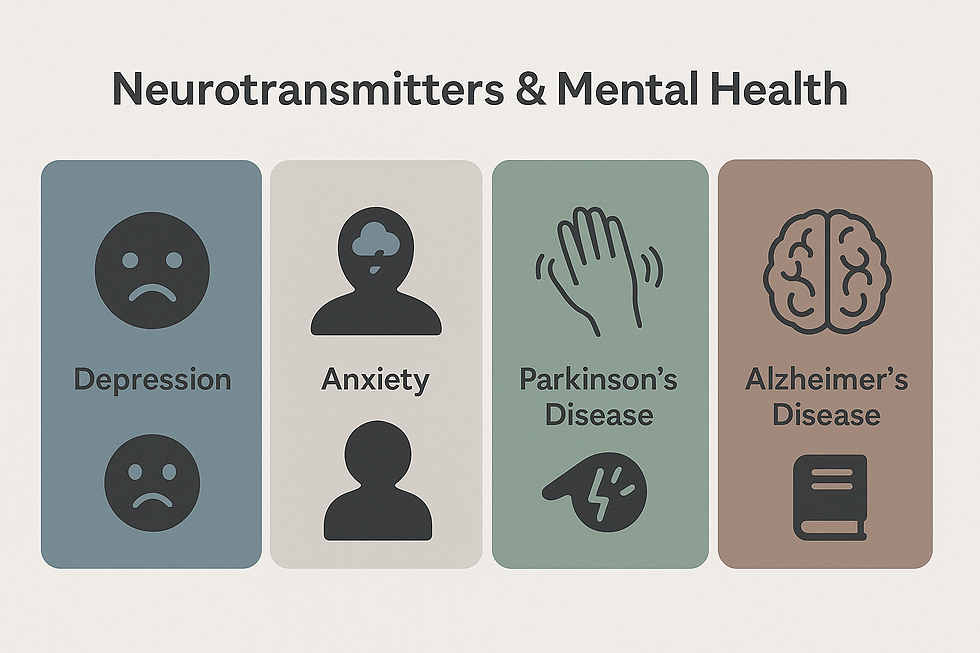
Changes in neurotransmission are linked to various neurological and psychiatric disorders:
Depression → associated with imbalances in serotonin, dopamine, and noradrenaline.
Anxiety → linked to GABA dysfunction.
Schizophrenia → complex alterations involving dopamine and glutamate.
Parkinson’s → degeneration of dopamine-producing neurons.
Alzheimer’s → loss of cholinergic neurons (acetylcholine).
That is why many medications act precisely in the regulation of neurotransmitters: antidepressants, anxiolytics, antipsychotics, and stimulants act to correct or modulate these chemical imbalances.
🌟 Conclusion

Neurotransmitters are the foundation of neural communication — the true chemical alphabet of the brain.
Understanding them means understanding how we think, feel, and act, as well as opening doors to new therapies in mental and neurological health.
More than a technical detail, they are the key to understanding the bridge between biology and human behavior.
📚 References and recommended readings
Kandel, E. R. Principles of Neural Science.
Bear, Connors & Paradiso. Neuroscience: Exploring the Brain.
Articles in Nature Neuroscience and Neuron.
Nolte, John. The Human Brain: An Introduction to Its Functional Anatomy.
Cosenza, R. M. Fundamentos de Neuroanatomia.


Comentários