THE MAIN BRANCHES OF NEUROSCIENCE
- Marcela Emilia Silva do Valle Pereira Ma Emilia
- 1 de jul. de 2025
- 5 min de leitura

🧠 The Main Branches of Neuroscience
Neuroscience is a vast and fascinating universe. It’s not a single, isolated science — it’s a multidisciplinary field that branches into several areas, each with its own focus, methods, and applications. Studies that use the “neuro” prefix may be related to people studying emotions, others memory, others still behavior, or artificial intelligence.
But after all, what are these areas? And what does each one study?
In this post, you’ll discover the main branches of neuroscience and understand how they help decode the mysteries of the brain — whether in the lab, clinic, school, workplace, or everyday life.
🧬 Molecular and Cellular Neuroscience

This is the most fundamental base of neuroscience. It studies the components that make up the nervous system: neurons, neurotransmitters, receptors, genes, and proteins.
It explores how neurons work and interact on a chemical and genetic level.It investigates neurotransmitters, genes, receptors, how all of this influences mental health and behavior, and the entire biochemistry involved in communication between nerve cells.
📌 Questions this area answers:
How do neurons communicate?
What happens to neurotransmitters in disorders like depression or Parkinson’s?
How are nerve cells formed and maintained?
🔍 What it investigates:
How neurons function on a molecular level
How genes affect brain function
Mechanisms of neurological and psychiatric diseases
📌 Applications:
Drug development
Research on diseases like Alzheimer’s, Parkinson’s, and epilepsy
🧠 Systems Neuroscience
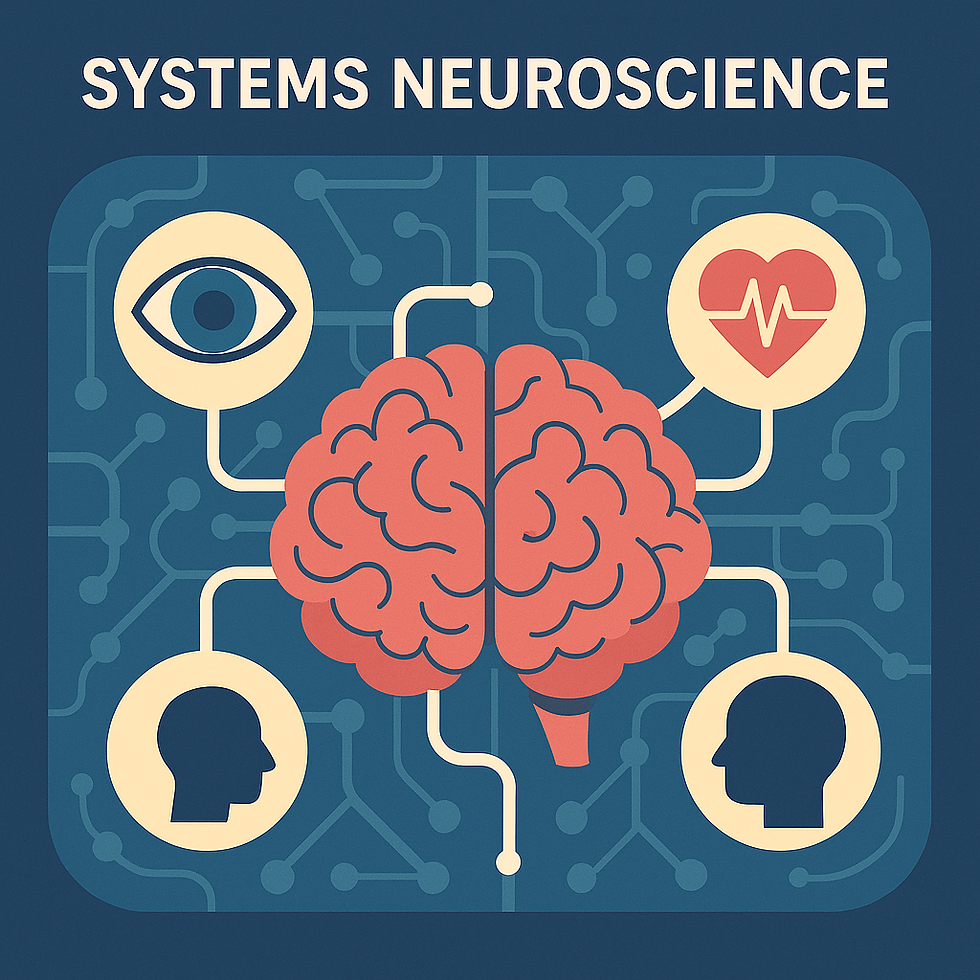
This area studies how groups of neurons and brain regions interact to generate behavior. It focuses on how different parts of the nervous system work together to produce complex functions like perception, movement, sleep, emotions, and behavior.
It looks at neural networks and brain circuits — not just isolated cells, but how they connect and interact to produce integrated responses from body and mind.
📌 Questions this area answers:
How do different regions of the brain communicate to create a unified perception?
Which brain circuits are involved in decision-making, attention, or motor control?
How do auditory, motor, and cognitive areas work together when we play an instrument, for example?
🔍 What it investigates:
How the brain controls sleep, appetite, movement, and emotions
Relationships between brain activity and observable behavior
📌 Applications:
Treatments for behavioral disorders
Research on memory, motivation, addiction, and learning
🧠 Neuroanatomy

This branch studies the structure of the nervous system — that is, how the brain, spinal cord, and nerves are physically organized.
Neuroanatomy is like the “physical map” of the nervous system, revealing where each structure is located and how they connect to form the basis of mind and behavior.
📌 Questions this area answers:
How are neural pathways organized for voluntary movement?
What changes in the brain of people with Alzheimer’s?
Where is the area responsible for memory located?
🔍 What it investigates:
Brain regions and subdivisions (e.g., prefrontal cortex, hippocampus, cerebellum)
Connections between neurons and brain areas
Anatomical differences in neurological conditions
📌 Applications:
Understanding brain damage
Neuroimaging studies (like fMRI)
Diagnosing lesions or neurological changes
🧍 Behavioral Neuroscience

This area investigates how the nervous system influences our behavior. It’s where brain, emotion, and action meet.
It explores the relationship between the brain and human and animal behavior. It’s the bridge between biology and what we feel, do, and decide. It studies how emotions, motivations, stress, and stimuli influence behavior. It’s the neural basis of addiction, trauma, habits, and emotional responses.
📌 Questions this area answers:
What happens in the brain when we feel fear?
How does stress alter our behavior?
How do traumas shape automatic reactions?
🔍 What it investigates:
How behavior develops throughout life (from birth to old age)
Individual differences in behavior based on brain biology
How environment and experience shape neural circuits and behavioral responses
📌 Applications:
Clinical psychology and therapy
Public mental health policies
Studies on addiction and compulsions
🧩 Cognitive Neuroscience
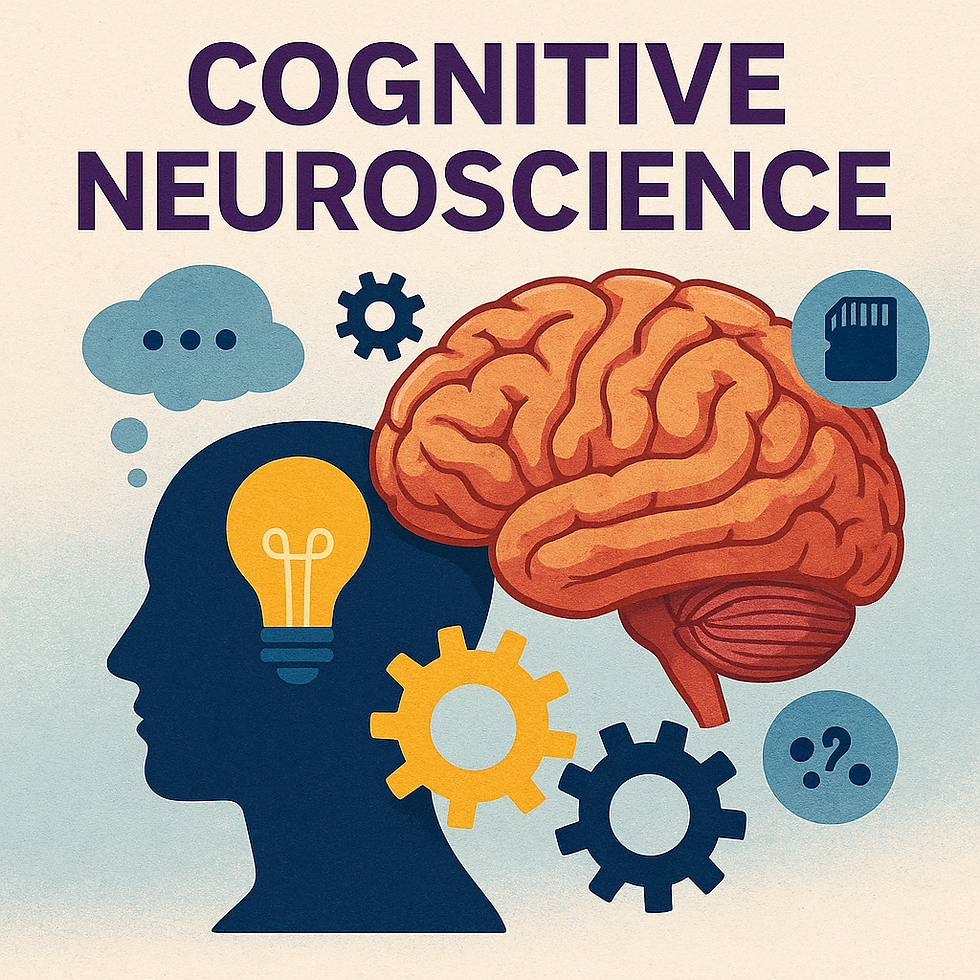
This area seeks to understand higher mental processes — how we think, feel, remember, and decide — and how they manifest in the brain.
These are considered higher mental functions — like thought, language, decision-making, and attention. Here, psychology and neuroscience meet, connecting brain and mind. It studies how the brain enables us to perceive, remember, decide, pay attention, speak, imagine, and create.
📌 Questions this area answers:
How does the brain form, store, and retrieve memories?
How do we make decisions and solve problems?
How do thoughts, beliefs, and mental images arise?
🔍 What it investigates:
How the brain processes information
How we make decisions and solve problems
Attention, language, memory, emotions
📌 Applications:
Education
Development of cognition-based technologies (e.g., AI)
Therapeutic interventions
🧑⚕️ Clinical Neuroscience

This field studies the diagnosis, treatment, and rehabilitation of neurological and psychiatric disorders. It is the bridge between scientific knowledge and medical practice.
It’s related to the diagnosis, prevention, and treatment of neurological and psychiatric conditions, such as epilepsy, Parkinson’s, depression, schizophrenia, and anxiety disorders.
📌 Questions this area answers:
What are the brain mechanisms behind diseases like Alzheimer’s, Parkinson’s, epilepsy, and multiple sclerosis?
What biomarkers can help with early diagnosis of neurological diseases?
How do different medications affect the brain and behavior?
🔍 What it investigates:
Nervous system diseases (like stroke, epilepsy, multiple sclerosis)
Psychiatric disorders (depression, anxiety, schizophrenia)
📌 Applications:
Development of tests and therapies
Cognitive rehabilitation
Personalized medicine
🧠 Computational Neuroscience

Here, brain and algorithm meet. This area uses mathematical models and simulations to understand how the brain processes information.
It uses mathematical models and artificial intelligence to simulate brain function. It’s the bridge between the human brain and the digital brain.
📌 Questions this area answers:
How do neurons and neural networks encode, transmit, and process information?
How can the structure and function of the brain inspire the development of more efficient artificial intelligence?
How can we simulate brain functioning in realistic computational models?
🔍 What it investigates:
Neural network modeling
Simulation of brain processes
Big data analysis in neuroimaging
📌 Applications:
Artificial intelligence
Brain-machine interfaces
EEG, fMRI, and eye-tracking analysis
🧠 Applied Neuroscience

This is where theory meets practice. This area uses neuroscientific knowledge to improve people’s lives — in education, marketing, business, public health, and design.
It brings neuroscience knowledge into daily life. It’s not about being in the lab, but about transforming environments, relationships, and experiences. This is neuroscience in the real world, using scientific discoveries to improve lives across multiple sectors.
📌 Questions this area answers:
How can we apply brain knowledge to improve learning in schools?
How can neuroscience help develop more empathetic and effective leaders in companies?
How can emotion regulation techniques based on neuroscience prevent stress and burnout?
🔍 What it investigates:
How to apply brain insights to everyday life
How the brain learns, decides, reacts to stimuli
📌 Applications:
Neuroeducation
Neuromarketing
Neurobusiness
Neuroethics
User experience (UX)
🧩 Other Emerging Areas
In addition to the ones already mentioned, new areas continue to emerge with the advancement of science and technology, such as:
Neuroethics – moral issues around brain technologies
Neuroeconomics – how we make financial decisions
Neuroaesthetics – how the brain perceives beauty and art
Neurolaw – how neuroscience influences justice
✨ Conclusion
Neuroscience is multiple, dynamic, and integrative. It connects with various fields of knowledge and life — and it continues to grow at a rapid pace.
Each of these areas, with its own methods and perspectives, helps expand our understanding of the brain, behavior, mind, and human experience.
Just like other professions and disciplines, neuroscience is not a single, closed field. It’s like a big puzzle with multiple pieces, each one revealing a part of the complex relationship between brain, mind, and behavior.
Whether you’re in healthcare, education, design, or leadership — understanding neuroscience’s areas is a powerful way to transform your work with more science, strategy, and awareness.
💜 Here at Mind the Brain…
We’ll continue exploring each of these areas with depth, accessibility, and responsibility. Because understanding the brain is understanding ourselves — and living more consciously, ethically, and informed.
If you liked this content, save, share, and tell me: which of these areas caught your attention the most? 👇


Comentários