NEUROSCIENCE VS. PSYCHOLOGY, MEDICINE AND COACHING: What is each, after all?
- Marcela Emilia Silva do Valle Pereira Ma Emilia
- 26 de jun. de 2025
- 3 min de leitura


🧠 Neuroscience vs. Psychology, Medicine, and Coaching: what is each, after all?
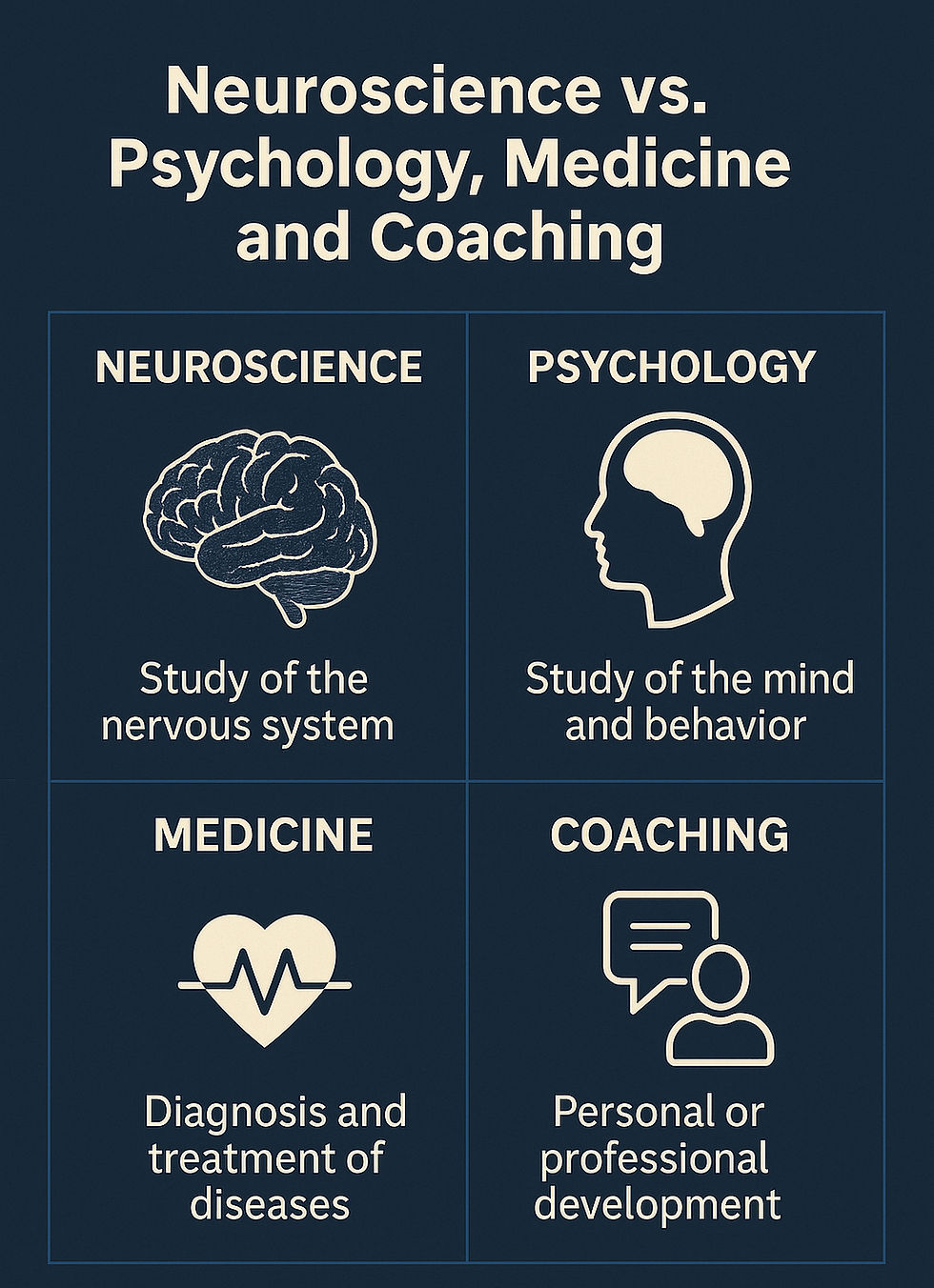
Neuroscience is related to psychology, but it is not psychology.
Medicine uses neuroscience, and neuroscience benefits from medicine, but neuroscience is not neurology.
Coaching can take advantage of neuroscience discoveries, but it is not based on science in its practice.
If you’ve ever heard — or thought — something like that about what neuroscience is, amidst so many professions and offers, this post is for you.
In this article, we’ll clearly and scientifically explain what neuroscience is, what it isn’t, and how it does (or does not) relate to psychology, medicine, and the much-talked-about coaching.
🔬 What is Neuroscience?
Neuroscience is an empirical, multidisciplinary science that studies the entire nervous system. Its main focus is the brain — but it also includes the spinal cord, peripheral nerves, and the complex network (both neuronal and non-neuronal) of connections that control emotions, behaviors, thoughts, decision-making, sleep, perception, and much more.
It is a field that integrates knowledge from biology, psychology, chemistry, physics, AI, engineering, mathematics, philosophy, and social sciences. And it’s built on real data, research, experimentation, brain imaging, and behavioral analysis.
Neuroscience seeks to understand how the brain generates the mind and how mental functions affect (and are affected by) our body, environment, culture, and experiences.
🧠 And what about Psychology?

Psychology is the science that studies human behavior and mental processes. This includes emotions, thoughts, social relationships, learning, development, trauma, beliefs, mental patterns, and many other aspects of the mind.
Psychologists work in various fields such as mental health, education, HR, sports, scientific research, therapy, and public policy.
🔁 Relation to neuroscience:Psychology raises questions about how we think, feel, and act. Neuroscience, in turn, investigates the biological foundations behind those responses. Many approaches in psychology incorporate neuroscience findings — but they are distinct fields.
🩺 And what about Medicine?

Medicine is the science that studies the human body and works in the diagnosis, prevention, and treatment of diseases. Within medicine, there are specialties like neurology (disorders of the nervous system) and psychiatry (mental disorders).
Doctors may use neuroscience to understand disease mechanisms, but their focus is on clinical care, prescribing medication, and health interventions.
🔁 Relation to neuroscience:Medicine benefits from neuroscience to improve diagnostics, therapies, and research. But neuroscience also exists outside of the medical context — in education, design, marketing, law, and many other sectors.
💬 And what about Coaching?

Coaching is a guidance process focused on personal or professional development. It is a practice that helps people set goals, plan actions, and overcome blocks — through questions, active listening, feedback, and motivation.
Coaching is not science and does not replace therapy or medical treatment. There are good professionals who try to base their work on scientific knowledge, but there is also a lot of pseudoscience disguised as neuroscience in this field.
🔁 Relation to neuroscience:None directly. Coaching can be inspired by neuroscience concepts, but using phrases like “activate your brain” or “reprogram your neurons” without scientific grounding is irresponsible.
🚫 What neuroscience is not:
❌ It’s not self-help dressed in a lab coat
❌ It’s not a motivational technique
❌ It’s not mind reading
❌ It’s not alternative medicine
❌ It’s not the same as coaching
❌ It’s not guesswork with “neuro” at the beginning
✅ What neuroscience is:
✔ A serious and empirical science
✔ Based on data, imaging, experiments, and statistics
✔ A field that evolves every day with incredible discoveries
✔ A bridge between brain function and human experience
✔ A lens to rethink how we live, learn, feel, and relate
📌 Conclusion
Being able to differentiate neuroscience, psychology, medicine, and coaching is essential to using knowledge responsibly — and avoiding empty trends.
Neuroscience has much to offer for our personal and professional development, but it must be used with rigor, ethics, and purpose.
🧠 Here at Mind the Brain, you’ll find neuroscience applied with depth, responsibility, and accessibility. No “neuro-babble” — just science with purpose.
Have questions? Drop them in the comments!And if you’d like more content like this, follow the blog. We’re just getting started.


Comentários